
Full funnel marketing plans content, channels and measures for every stage a buyer goes through, from first awareness to purchase and beyond. It replaces the habit of pushing one channel hard and hoping the rest takes care of itself. This guide explains the TOFU, MOFU and BOFU stages, why the gaps between them cost you leads, and how to build a plan in five steps. It closes with how to measure each stage and an enrolment funnel example for education brands.
What is full-funnel marketing?
Full-funnel marketing is a way of planning marketing around every stage of the buyer journey, from awareness to purchase and beyond, instead of only the moment someone is ready to buy. Each stage gets content that answers the buyer's question at that point, a channel where that question is asked, and a measure that fits the stage. The funnel shape comes from numbers. A large group hears about you, a smaller group compares options, and fewer still buy.
The funnel stages: TOFU, MOFU and BOFU
Each stage of the funnel matches a different question in the buyer's mind.
The classic model has three stages, namely top of the funnel (TOFU), middle of the funnel (MOFU) and bottom of the funnel (BOFU). Some teams add a fourth stage after the sale, because keeping a customer is usually cheaper than finding a new one. The table sets out the goal, the buyer question per stage, the content, the channel and the metric per stage. Use it as a checklist when you review your own marketing, and mark any row where you have nothing in place.
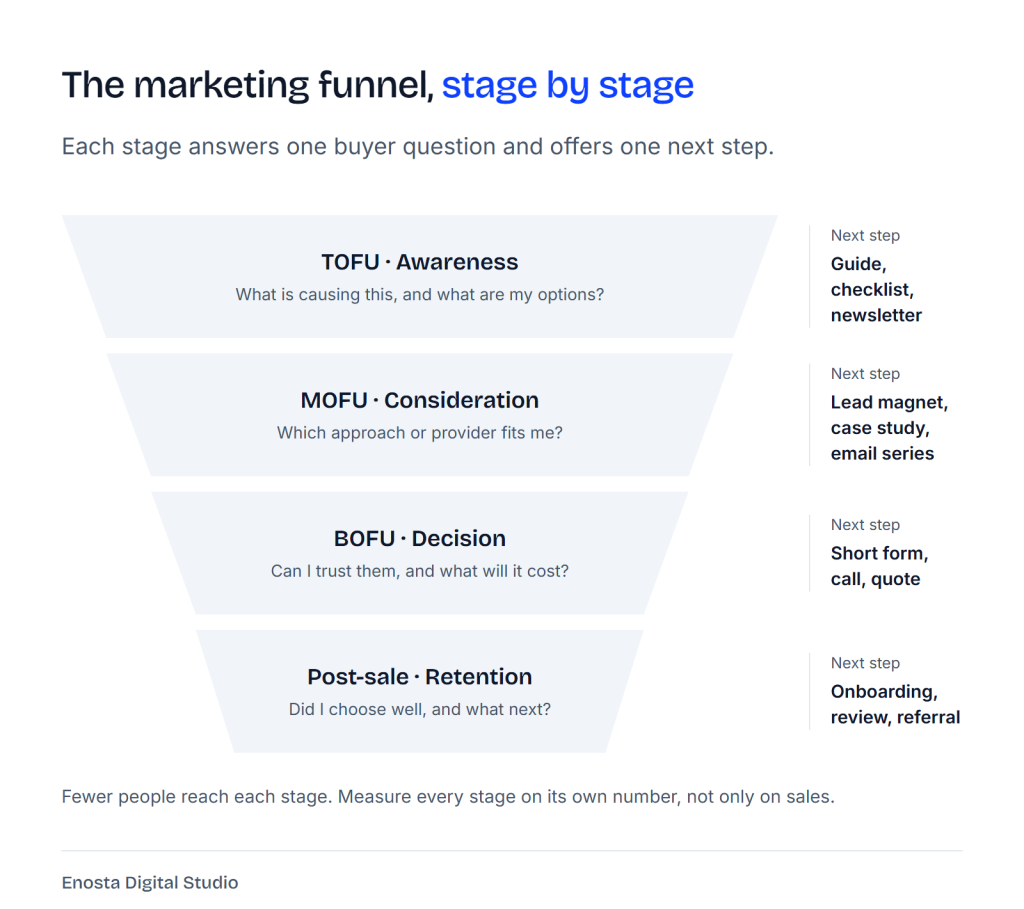
| Stage | Goal | Buyer question | Content | Channel | Metric per stage |
|---|---|---|---|---|---|
| TOFU: Awareness | Be found by people with the problem | What is causing this, and what are my options? | Guides, explainers, short videos, social posts | Organic search, social media, video, display ads | Impressions, reach, new visitors |
| MOFU: Consideration | Be shortlisted | Which approach or provider fits me? | Comparisons, case studies, webinars, lead magnet | Search, email, retargeting, LinkedIn | Engaged sessions, email sign-ups, leads |
| BOFU: Decision | Win the choice | Can I trust them, and what will it cost? | Service and pricing page, reviews, demos, consultations | Branded search, paid search, sales calls, email | Enquiries, conversion rate, cost per lead, sales |
| After the sale | Keep and grow customers | Did I choose well, and what next? | Onboarding, tips, check-ins, referral offers | Email, account management, community | Repeat purchases, reviews, referrals |
Top of the funnel (TOFU): Awareness
At the top, people know they have a problem or a goal but not the solution. A café owner searches "why are my bookings down"; a parent searches "how to choose a secondary school". Your job is to be helpful and findable, not to sell.
Top-funnel content works when it answers the question better than anything else the reader finds. Write in the buyer's words, explain causes and options honestly, and show you understand their situation. Good formats are how-to guides, explainers, checklists, short videos and posts that teach one idea. Organic search and social media carry most of this stage, with paid social or video used to reach people who match your best customers.
Every top-funnel piece needs a soft next step, otherwise readers leave and forget you. Link to a related comparison or case study, offer a checklist that goes deeper, or invite readers to a newsletter with one useful tip a week. The aim is the second visit, not the sale.
Middle of the funnel (MOFU): Consideration
In the middle, buyers compare approaches and providers. They read case studies, download checklists and ask colleagues. This is the stage where you earn permission to follow up, usually with an email address in exchange for something useful.
Middle-funnel content helps people decide how to solve the problem and who to trust with it. Comparisons of approaches, honest pros and cons, case studies with the steps you took, buyer guides and webinars all work here. A lead magnet, such as a template, checklist or calculator, turns an anonymous reader into a contact you can follow up.
Once someone gives you their email, a short nurture sequence keeps the conversation going. A simple five-email sequence for a service business might look like this:
- Email 1, same day: Deliver the resource and explain how to use it in one paragraph.
- Email 2, day 3: Share the most common mistake people make with the problem, and how to avoid it.
- Email 3, day 7: Tell one customer story, covering the situation, what you did and what changed.
- Email 4, day 12: Answer the top objection, such as cost, time or risk.
- Email 5, day 18: Invite a reply or a short call, with a clear reason to book now.
Retargeting ads can repeat the same story for people who visited key pages but did not leave their details.
Bottom of the funnel (BOFU): Decision
At the bottom, buyers check price, proof and risk. Clear service pages, honest pricing, real reviews and a fast response to enquiries matter more here than clever campaigns.
Bottom-funnel pages should answer the last questions before someone acts. State who the service is for, what is included, how long it takes, what it costs or how pricing works, and what happens after they enquire. Put proof next to the form, keep the form short and name the button after the action, such as "Book a 20-minute call".
Speed of reply is part of this stage. A lead that waits two days often books with someone else. Set a reply target, send an automatic confirmation that says when you will call, and track how many enquiries become sales calls and how many become customers.
After the sale: Retention and advocacy
After the purchase, the funnel continues with retention and advocacy. Good onboarding, useful follow-up and a simple way to leave a review turn customers into repeat buyers and referrers, who then feed the top of the funnel again.
Plan this stage like the others. Write a welcome email or call script, check in at the point where customers usually have questions, and ask for a review once they have seen a result. A referral offer works best when it is simple and shared at a happy moment, such as after a successful launch or a good report.
Why full-funnel marketing matters
Full-funnel marketing matters because each stage depends on the one before it.
When a business runs only bottom-funnel ads, it competes for a small group of people who are ready to buy today. Results look good at first, then the cost per lead rises as that group is used up. When a business publishes only top-funnel content, traffic grows but few visitors take a next step, because nothing helps them compare or decide. And when teams judge everything with last-click reports, top-funnel work looks worthless, because the first visit rarely gets credit for the final sale.
A quick way to find the weak stage is to start from the symptom:
Few people find you
The top of the funnel is thin. Publish helpful content for the questions buyers ask before they know your name.
Traffic but no enquiries
The middle is missing. Add comparisons, case studies, a lead magnet and a clear next step on popular pages.
Enquiries but few sales
The bottom needs work. Check pricing clarity, proof, response time and the sales follow-up.
Rising cost per lead
Paid ads are carrying the whole funnel. Build organic and email stages so ads are not the only source.
One-off customers
The after-sale stage is missing. Plan onboarding, check-ins and a simple referral ask.
How to build a full-funnel marketing strategy
A full funnel marketing strategy starts with buyer questions, not with channels.
Step 1: Write down the questions buyers ask
Map buyer questions for each stage. Talk to sales staff, read enquiry emails and check what people search for. Write ten to twenty real questions in the buyer's words, then sort them into awareness, consideration, decision and after the sale. This list becomes the brief for everything else.
Step 2: Audit what you already have for each stage
Audit content per stage. List your existing pages, posts, emails, videos and ads, and match each one to a stage and a question. Most small businesses find plenty of bottom-funnel material, such as service pages and offers, and very little in the middle. The gaps on this list are your priorities.
Step 3: Choose channels where those questions are asked
Choose channels by where each question is asked, not by habit. Early questions often go to Google, YouTube or social media; comparison questions go to search, peers and email; decision questions come through branded search, referrals and direct contact. Start with one or two channels per stage that you can run well, rather than many channels done badly.
Step 4: Fill the gaps and connect the stages
Fill gaps with the missing content, then connect stages so people can move forward. Every top-funnel guide should link to a relevant comparison or case study. Every middle-funnel page should offer a clear next step, such as a checklist, a consultation or a quote. Every enquiry should get a fast, personal reply. The links between stages are often worth more than another new piece of content.
Step 5: Set one measure per stage and review monthly
Measure each stage with its own number, and review them together once a month. If awareness grows but leads do not, work on the middle. If leads grow but sales do not, work on the bottom and the sales hand-over.
A 90-day plan to get started
If you are starting from scratch, a 90-day plan keeps the work focused on one gap at a time.
- Weeks 1 to 2, audit: List buyer questions, map existing content and channels to each stage, set up form tracking and lead source fields in your CRM, and record a baseline for each stage.
- Weeks 3 to 6, fix the bottom: Tighten service and pricing pages, add proof near every form, shorten forms and set a reply target for new enquiries.
- Weeks 7 to 10, build the middle: Publish one comparison page and one case study, create a lead magnet, and write a five-email nurture sequence.
- Weeks 11 to 13, feed the top: Publish three to four guides that answer early questions and link each one to the middle-funnel pages. Review the stage measures and choose the next gap.
The order matters. Fixing the bottom first means every new visitor you attract later has a clear path to becoming a customer.
Our full-funnel planner puts the stage table, the symptom checker and this 90-day plan in one spreadsheet you can fill in with your team.

Get the full-funnel planner
Enter your details and we will send the Excel planner to your inbox.
What content fits each stage
Content fits a stage when it matches the search intent behind the question.
Search intent is the reason behind a search. Informational intent ("what is", "how to") belongs at the top, commercial intent ("best", "vs", "reviews") sits in the middle, and transactional intent ("price", "quote", "book") belongs at the bottom.
Awareness content
How-to guides, explainers, checklists and short videos that answer informational intent without a hard sell.
Consideration content
Comparisons, case studies, buyer guides, webinars and a lead magnet such as a template or calculator, aimed at commercial intent.
Decision content
Service pages, a clear pricing page or price guide, reviews, demos and an easy booking or quote form for transactional intent.
After-sale content
Onboarding emails, help articles, customer stories and referral offers that keep customers engaged.
One strong piece can serve two stages. A detailed guide can teach the basics and end with a comparison of approaches and a link to your service, which moves the reader from awareness towards consideration on the same page.
How to measure each stage
Each stage needs its own measure, because judging the top by sales hides what it contributes.
- Awareness: Impressions and clicks in Google Search Console, reach and video views on social, and new visitors in Google Analytics 4.
- Consideration: Engaged sessions, returning visitors, email sign-ups, lead magnet downloads and leads from forms.
- Decision: Enquiries, conversion rate from enquiry to sale, cost per lead on paid channels and time to first reply.
- After the sale: Repeat purchase rate, reviews, referrals and customer lifetime value.
Two numbers tie the stages together. Customer acquisition cost is the total marketing and sales spend divided by new customers in the same period. Customer lifetime value is the revenue a customer brings over the whole relationship. If acquisition cost creeps towards lifetime value, the funnel is leaking somewhere.
Here is a worked example with round figures, for illustration only. A consultancy spends $4,000 a month on marketing and sales time and wins five new clients, so its customer acquisition cost is $800. Each client pays $500 a month and stays about 18 months, so customer lifetime value is around $9,000. The funnel is healthy. If the same spend wins only two clients, acquisition cost rises to $2,000, and the stage measures show where the drop happened. Fewer leads points to the top or middle, while fewer sales from the same leads points to the bottom.
To see the whole path, record the source of every lead in your CRM, use UTM parameters on campaign links, and mark form submissions as key events in Google Analytics 4. Then compare first-touch and last-touch sources from time to time, so top-funnel channels get credit for the leads they start.
Example: an enrolment funnel for an education brand
Schools, colleges and training providers run the same model under different names: an enrollment funnel or admissions funnel.
Here is a hypothetical funnel for a private college recruiting domestic and international students. Parents and students both take part in the decision, so each stage speaks to both.
Awareness
Short videos of student life, course explainers and guides such as "how to choose a business diploma", promoted on social and found through search.
Consideration
A course comparison page, a downloadable course guide in exchange for an email, and invitations to a virtual or on-campus open day.
Enquiry
A short enquiry form on each course page, a chat option and a reply from admissions within one business day.
Application
A clear application checklist, reminder emails for missing documents and a contact person for questions about fees and visas.
Enrolment
Offer letters, payment steps and an orientation email series.
Retention and advocacy
Student check-ins, alumni stories and a referral invitation that feed the next intake.
The useful measures here are enquiries per course, open day sign-ups and attendance, application completion rate and enrolment rate by source. The weak point in many enrolment funnels is the gap between enquiry and application, where families wait for answers. A fast, personal reply often does more than another round of ads. You can see how we approached recruitment marketing in our education social media case study.
Common full-funnel mistakes
Most funnel problems come from a handful of habits, and each has a simple fix.
- Judging TOFU by sales: Top-funnel content rarely closes a sale on the first visit. Judge it by reach, new visitors and how many readers move to the next stage.
- No follow-up: Leads arrive and wait days for a reply. Set a reply target and automate the first response.
- Too many channels: Spreading a small budget across every platform leaves each one weak. Do fewer channels well.
- No hand-over between marketing and sales: Marketing counts leads, sales complains about quality. Agree on what a qualified lead is and review lost leads together.
- Content without next steps: Popular posts end with no link, offer or form. Add one relevant next step to every page.
When to work with a full-funnel marketing agency
Many small businesses run the funnel in-house and bring in help for the parts they cannot staff.
Signs you may need outside help:
- Traffic, leads and sales are reported separately and nobody owns the whole picture.
- Paid ads are the only reliable source of leads and costs keep rising.
- You lack skills for one stage, such as SEO, video or email automation.
A full funnel marketing agency plans and runs several stages together, while a sales funnel agency often focuses on the bottom: landing pages, ads and conversion. Whichever you choose, know what to ask before you sign:
- Which stages and channels will you run, and which stay in-house?
- What will you measure at each stage, and how often will we review it?
- Who writes the content, and how do you check it matches our brand and buyers?
- How will leads reach our sales team, and how fast?
Our team plans and runs digital marketing services across search, social, creative and paid media, with a measure for each stage.
Frequently asked questions
How many stages does a marketing funnel have?
Most models use three stages: awareness, consideration and decision. Many add a fourth after the sale for retention and advocacy. Some split stages further, but three or four are enough to plan content and measures.
Is full-funnel marketing only for large budgets?
No. A small business can cover every stage with a few strong guides, one comparison page, a simple email sequence and a fast reply to enquiries. The plan matters more than the budget.
How long does it take to see results from a full-funnel strategy?
Bottom-funnel fixes such as faster replies or clearer pricing can show results within weeks. Top-funnel content and organic search usually take several months to build. Review each stage monthly so you can see progress before sales catch up.