A brand strategy is a short set of long-term decisions about why your business exists, who it serves, how it is different and how it should sound. It guides design, copy, marketing and hiring, so every choice can be checked against the same reference and the difference from competitors stays clear. This guide explains what goes into a brand strategy, how it differs from marketing strategy and brand identity, and how to write a one-page version with your team. It also covers what a brand strategist does and how to put the strategy to work online.
What is brand strategy?
A brand strategy is a written set of decisions about a business's purpose, audience, positioning, values, personality and key messages. It changes rarely and guides the visual identity, the copy and every marketing campaign. A good one fits on one or two pages, so the whole team can use it.
Think of it as the brief behind the brand and a guide for design and marketing. Designers use it to choose a look, writers use it to choose words, and managers use it to decide which opportunities fit. Without it, each of these choices relies on personal taste.
Brand strategy vs marketing strategy
Brand strategy decides who the business is, while marketing strategy decides how to reach and convert people right now.
The two work together, but they run on different clocks. A brand strategy should hold for years. A marketing strategy changes with each budget, channel and campaign. Brand identity sits between them as the visible and verbal expression of the brand strategy.
| Brand strategy | Marketing strategy | Brand identity | |
|---|---|---|---|
| Question it answers | Who are we, for whom, and why us? | How do we reach and convert people this year? | What do people see and hear? |
| Timeframe and what changes | Rarely, reviewed yearly | Often, by quarter or campaign | Rarely, with a refresh or rebrand |
| Main owner | Founders and leadership | Marketing team | Design and marketing teams |
| Example output | Positioning statement, values, key messages | Channel plan, budget, campaign calendar | Logo, colours, type, tone of voice |
The old saying "marketing is what you do, branding is what you are" captures the split. For the visual and verbal parts that come out of a brand strategy, see our guide to the components of brand identity.
Why a brand strategy matters
A brand strategy matters because it ends the guesswork that slows down every design, copy and marketing decision.
You can usually spot a missing brand strategy by its symptoms:
- No team alignment: Each team member explains the business in a different way.
- Slow decisions: Design and copy reviews turn into arguments about taste, instead of faster decisions against agreed rules.
- No consistent messages: Every campaign introduces a new promise.
- Weak briefs for designers and writers: Agencies and freelancers ask the same basic questions each time.
- Wasted work: New assets are made, then reworked because they "do not feel right".
A written strategy fixes these by giving everyone the same reference. It also makes briefs shorter, because the basics are already agreed. Even a small business benefits, because a single page is enough to start.

Get the one-page brand strategy template
Enter your details and we will send the Excel template to your inbox.
What goes into a brand strategy
A brand strategy usually covers six parts, from purpose to brand architecture, and each part has a clear question to answer.
Purpose, vision and mission
Purpose explains why the business exists beyond making money. Vision describes the future you want to help create. Mission says what you do every day to get there. Small businesses often combine these into one or two sentences.
- What to write: One sentence each for purpose, vision and mission, or one combined statement.
- Example: Patagonia states its purpose plainly on its ownership page: "We're in business to save our home planet."
- Example: IKEA describes its vision on its company pages as "to create a better everyday life for the many people".
Values
Values describe the behaviours the business expects when nobody is checking. Keep the list short, so people can remember it. Three to five values is a common range.
- What to write: Each value as a short phrase, plus one sentence on what it looks like in practice.
- Example: "Clear over clever. We explain things in plain words, even when the topic is technical."
Target audience
The target audience is the group your business serves best. Describe them by their situation, the jobs they need done, their problems and goals, not only by age or job title. Saying who it is not for is just as useful.
- What to write: Your primary audience, their main problem, what they want to achieve and who you do not serve.
- Input: Customer research, such as interviews and sales notes, is the best source.
Positioning and value proposition
Positioning is the place you want to hold in your customers' minds compared with the alternatives. The value proposition is the main benefit you promise and why it is believable. Both need a competitor analysis, because differentiation is the whole point of a position.
- What to write: A positioning statement in one or two sentences, plus a value proposition with two or three proof points.
- Format: "For [audience] who [need], [brand] is the [category] that [main benefit], because [reason to believe]."
Personality, voice and key messages
Personality describes the brand as if it were a person. Tone of voice turns those traits into writing rules. Key messages are the few points every page and pitch should support, and the brand story explains where the business came from and why.
- What to write: Three to five personality traits, do and don't writing rules, three to five key messages, a short brand story and a tagline if you use one.
- Example: A trait such as "direct" becomes a rule: "Lead with the answer, then explain."
Brand architecture
Brand architecture explains how the main brand relates to any sub-brands, products or services. Some businesses use one brand for everything. Others give a product its own sub-brand, either as an endorsed brand ("by" the parent) or as a fully separate name.
- What to write: A simple map of the parent brand and any sub-brands, with naming rules for new products.
A one-page brand strategy framework
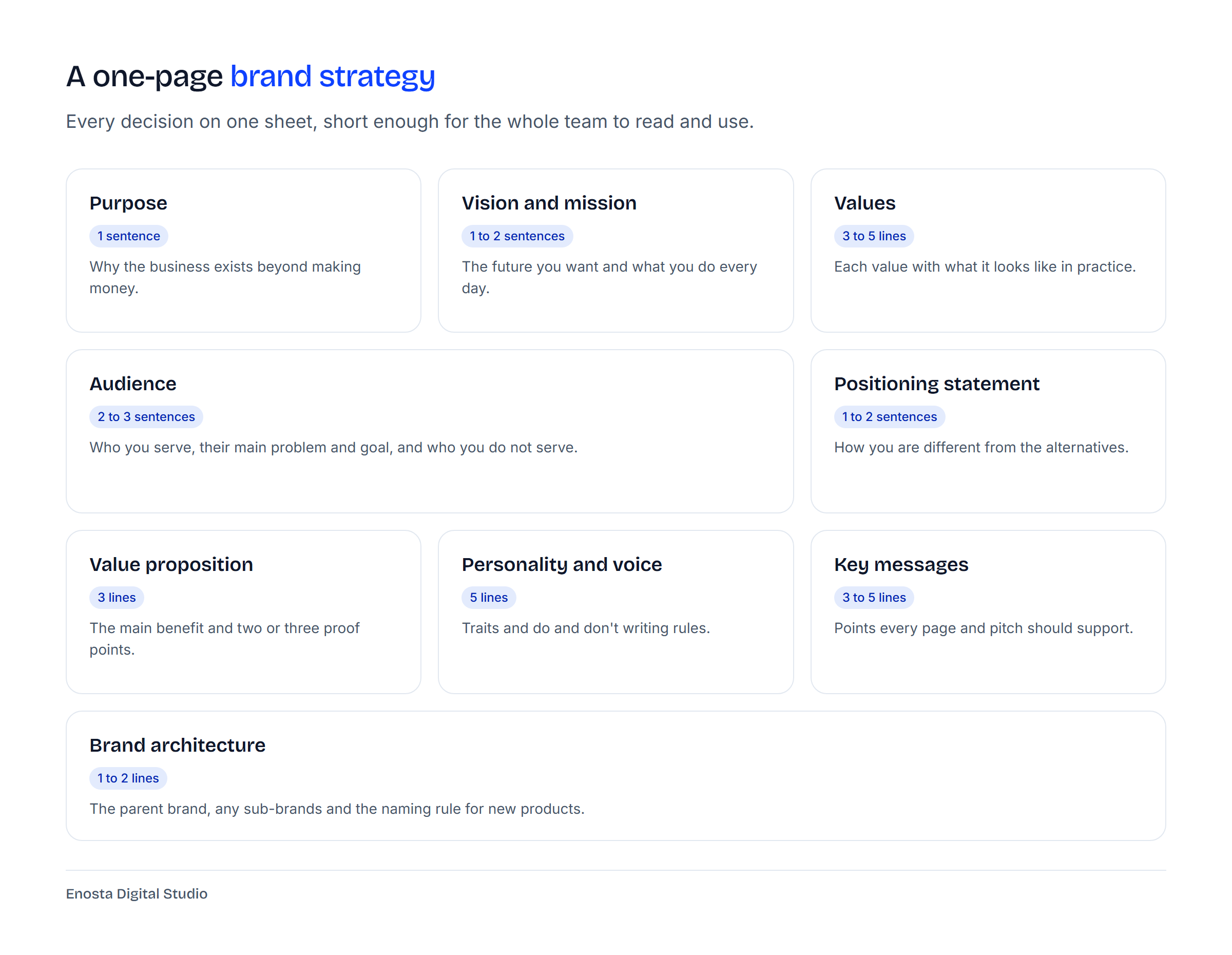
A brand strategy framework puts every decision on one page, so the team can actually read and use it.
Use this layout as a starting point. Keep each field short, because a long strategy is rarely read.
| Field | What to write | Length |
|---|---|---|
| Purpose | Why the business exists | 1 sentence |
| Vision and mission | The future you want and what you do daily | 1 to 2 sentences |
| Values | Three to five values with one line each | 5 lines |
| Audience | Who you serve, their problem and goal | 2 to 3 sentences |
| Positioning statement | How you are different from alternatives | 1 to 2 sentences |
| Value proposition | Main benefit and proof points | 3 lines |
| Personality and voice | Traits and writing rules | 5 lines |
| Key messages | Points every page should support | 3 to 5 lines |
| Brand architecture | Parent brand and sub-brands | 1 to 2 lines |
How to create a brand strategy
You can create a brand strategy in six steps, from gathering the right people to reviewing the finished page.
Gather
Bring together founders and people who talk to customers.
Draft and test
Write the decisions, then test them on real copy and customers.
Share and review
Publish one page and check it every year.
- Gather the right people. Include founders, someone from sales and someone from customer service. Keep the group small enough to decide, usually three to six people.
- Research customers and competitors. Interview five to ten customers about why they chose you. List how competitors describe themselves and where they all sound alike.
- Draft the decisions. Work through the framework one field at a time. Write first, then cut, because short answers are easier to use.
- Test on real copy. Rewrite your homepage headline and a sales email using the draft. If the result sounds generic, the positioning needs more work.
- Share one page. Publish the final version where everyone can find it, and walk the team through it.
- Review once a year. Check the strategy annually, or sooner if the business changes its offer, market or audience.
An outside facilitator can help with steps 1 to 4. They keep workshops neutral and push for decisions when the group goes in circles.
What a brand strategist does
A brand strategist turns research and workshops into the positioning, messaging and briefs that design and marketing teams need.
The role usually covers these tasks:
- Research: Customer interviews, competitor reviews and audits of current touchpoints.
- Workshops: Sessions that help leaders agree purpose, audience and positioning.
- Positioning and messaging: Writing the positioning statement, value proposition and key messages.
- Briefs: Turning the strategy into clear briefs for designers, writers and agencies.
When to hire one comes down to three situations. The first is a new business or product that needs a clear position before launch. The second is a repositioning, when the business has changed but the brand has not. The third is a team that keeps debating the same questions without reaching a decision. Strategy often leads straight into identity work, which our Design service covers alongside brand and visual identity.
Putting your brand strategy to work online
A brand strategy only pays off when your website, search results and social channels say the same thing it does.
Review each online touchpoint against the strategy:
- Website: Check that the homepage headline, service pages and about page reflect your positioning and key messages. Our Websites team often starts redesigns from this check.
- Search results: Make sure page titles and meta descriptions use your value proposition, not generic phrases.
- Social media profiles: Align bios, profile images and pinned posts with the brand personality and voice.
- Content: Plan articles and posts that support your key messages, rather than chasing every trend.
- Ads: Keep promises in ads consistent with the positioning, so people find what they expected when they click.
- Monitoring: Track how people describe you in reviews, comments and sales calls, and compare it with your strategy.
Our Marketing & Creative team uses the same approach when planning search and social work.
Brand strategy mistakes to avoid
Most brand strategies fail because they are too long, too vague or left unused.
- Too many values: A list of ten values is hard to remember. Keep three to five and explain each one.
- Copying competitors: If your positioning statement would fit a rival, it is not a position yet.
- A document nobody uses: A long slide deck sits in a folder. One page, shared and referenced, gets used.
- Changing with every campaign: Campaigns should follow the strategy, not rewrite it each quarter.
Frequently asked questions
How long does it take to create a brand strategy?
A small business can draft a one-page brand strategy in a few focused workshops over two to four weeks, including customer interviews. Larger businesses with several audiences or sub-brands often need longer, because more people must agree.
How often should a brand strategy change?
A brand strategy should stay stable for several years. Review it once a year and change it when the business changes what it sells, who it sells to or where it competes. Small wording updates are fine, but frequent changes defeat its purpose.
Should brand strategy come before a logo or website?
Yes. The strategy gives designers and developers the reasons behind their choices. A logo or website built first often has to be reworked once the strategy is clear.
Can a one-person business have a brand strategy?
Yes. Consultants, freelancers and founders benefit from a short strategy, because it keeps their website, social profiles and pitches consistent. One page with purpose, audience, positioning and voice is enough.